
















 Robot Lawn Mowers





















 Humidifiers


 Smart Door Lock


 Canada
 Australia
 中国大陆
中国大陆 日本
日本


 Türkiye


 Ireland
 Portugal
 Italia
 Netherlands
 Belgium
 Greece
 Polska
 Norway
 Sweden
 Finland
 Denmark
 Hungary
 Czechia
 Slovenia
 Croatia
 Switzerland
 United
Kingdom
United
Kingdom


 Colombia

In this article
A freshly striped lawn gives your yard that same ballpark or golf-course polish, and it's more doable than it looks.
The right patterns can turn a plain mow into something sharper, from classic straight lines to checkerboards, curves, and more creative designs. Here are seven unique lawn striping patterns to try, plus practical tips for cleaner and more consistent lines.

What Makes Lawn Stripes Appear
Lawn stripes are a trick of the light, not a change in the color of your grass. Grass bent toward you looks darker, while grass bent away reflects more light and looks lighter.
Alternating mower passes bend the blades in opposite directions to create the familiar light-and-dark effect. Healthy, dry grass with enough length to bend usually shows the strongest contrast.
How Lawn Striping Patterns Keep Grass Healthier
Changing your pattern does more than keep the lawn looking sharp. Mow the same direction every week, and the blades stay bent the same way, so the grass grows at an angle instead of upright. The lawn ends up looking flat and thin, and your stripes lose their contrast.
Your wheels also roll over the same strips of soil on every pass, pressing them down until roots have less room to spread. Alternating between different lawn striping patterns fixes both these problems.
7 Unique Lawn Striping Patterns to Try
Each pattern below comes with a difficulty rating, the yards it suits, and how to mow it. Start with a design that fits your lawn's size, shape, and layout, then work up to more detailed cool lawn mowing patterns once your passes stay even.
1. Classic straight stripes
Difficulty: Easy
Best for: Small to large lawns and first-time striping.
Mow from one end of the lawn to the other, then return beside your first pass in the opposite direction. Use a driveway, fence, or patio edge as your guide.
Straight lawn striping patterns suit almost any yard and can make a narrow lawn appear longer.

2. Diagonal stripes
Difficulty: Easy
Best for: Small, wide, or shallow lawns.
Diagonal stripes run corner to corner instead of following the edges of your lawn. The angled lines add depth and can make a compact space feel wider.
Start in one corner and mow straight toward the opposite one, fixing your eye on something past it so the line stays true, then run every pass alongside the last.

3. Checkerboard
Difficulty: Easy to moderate
Best for: Square or rectangular lawns.
A checkerboard lawn is straight stripes mowed twice, with the second set running across the first. Mow the whole lawn in straight passes, then mow it again from the side so your new lines cross the old ones at 90 degrees.
The squares appear where the two sets of stripes overlap.

4. Diamond
Difficulty: Moderate
Best for: Large, open lawns with minimal obstacles.
A diamond pattern is a checkerboard done at an angle. Mow diagonal stripes corner to corner, then mow a second set from the other two corners so the lines cross at an angle instead of square ones.
That angled crossing is what turns the squares into diamonds, so keep both sets evenly spaced, or the shapes come out uneven.

5. Wavy or curved
Difficulty: Moderate
Best for: Landscaped or irregular-shaped yards.
Curved stripes bend gently instead of running straight, so they suit yards with rounded beds or winding paths. Trace your first pass along an existing curve, a bed edge or a path, then copy that line with each pass after it.
Keep the bend broad, because every pass copies the one before it and a tight turn only gets more exaggerated the further out you go.

6. Spiral
Difficulty: Advanced
Best for: Large, open lawns
Start at the outside edge and mow one full lap around the perimeter, then keep circling, moving in by one mower width each time. Working inward means the lawn edge gives you your first line and every lap after that copies the last.
The turns get too tight to follow near the middle, so circle only as far as your mower turns comfortably and finish the small center patch with a trimmer.

7. Circular or concentric
Difficulty: Advanced
Best for: Lawns with a tree, flower bed, or another central feature.
Mow repeated circles around the central feature, using each pass to guide the next. Keep the spacing even so the layered effect stays clear.
If the turns become too tight near the center, finish that area separately.

How to Get Cleaner Stripes
Direction, mowing height, and a clean finishing pass make the biggest difference when learning how to stripe your lawn. The rest of this section covers what you need and the order to mow in.
What you need
A standard mower can create stripes if its wheels and deck bend the grass firmly enough. A rear roller or striping kit presses the blades more evenly, making the contrast stronger and longer-lasting, though for a home lawn you rarely need one.
Use sharp blades and mow when the grass is dry. Dull blades tear the tips, while wet grass can clump or leave wheel marks. Our guide to the best time of day to mow covers when the grass is driest through the day.
Step by step
If this is your first time striping, practice running straight stripes before anything else, since every other pattern in this post builds on the same foundation.
- Mow one lap around the edge of the lawn. That gives you room to turn at the end of each pass without leaving turn marks across grass you haven't striped yet.
- Line your first pass up against a straight edge, like a fence or driveway.
- Fix your eye on something at the far end of the lawn and mow toward it so the line stays true.
- Overlap by one wheel width. Run one wheel along the edge of your last pass so no uncut strips show between the lines.
- Mow the return pass in the opposite direction so the grass bends the other way. The contrast between the two is the stripe.
- Keep your speed and spacing even the whole way across.
- Finish with one more lap around the edge to tidy your turn marks.
Good striping starts with an even cut. If you're new to mowing, our beginner's guide to how to mow a lawn properly covers cutting height, pass direction, and how to keep the finish level.
Pro tips
- Keep enough grass height for the blades to bend naturally. Avoid removing more than one-third of the blade in one session.
- Change direction each time you mow. Alternating between straight and diagonal routes helps the grass stay upright and prevents repeated wheel tracks.
- Mow often enough to remove small amounts of growth. Knowing how often to mow your lawn can help you maintain crisp lines without stressing the grass.
Patterns That Suit Smaller or Irregular Yards
The best pattern isn't always the most detailed one. For smaller, sloped, or obstacle-filled lawns, choose a design that fits the space and stays easy to follow.
| Yard type | Recommended pattern | Why it works |
|---|---|---|
| Small or narrow lawn | Straight or diagonal stripes | Simple lines are easy to maintain and can make the lawn appear longer. |
| Short and wide lawn | Diagonal stripes | Angled lines add depth and can make the space feel wider. |
| Landscaped or irregular lawn | Wavy or curved stripes | Curves follow existing borders and work well around trees, beds, and pathways. |
| Sloped lawn | Straight stripes | Simpler passes are easier to follow consistently and help maintain a cleaner finish. |
Getting Stripes Without the Weekly Effort
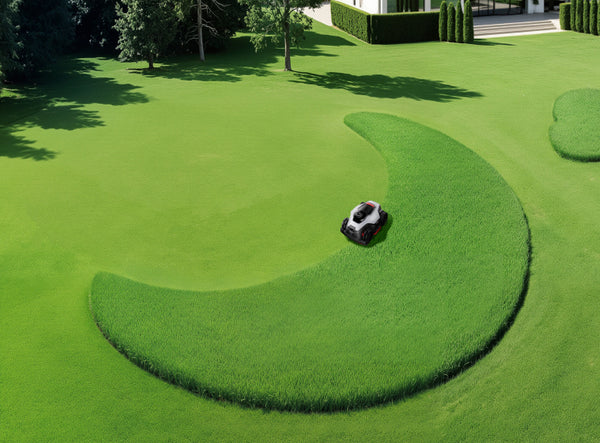
A robot lawn mower that follows planned mowing routes can repeat consistent patterns across your lawn, so you don't have to spend time maintaining them yourself.
The Dreame A3 AWD Pro Series lets you choose three cutting directions in the Dreamehome app. Custom follows your selected angle, Checkerboard uses 90-degree cross-cutting, and Rotate changes the direction by 45 degrees between sessions.
You can also create artistic shapes, including hearts and geometric designs. Instead of planning each pass yourself, you set the pattern in the app and let the mower follow the route.
[product handle="a3-awd-pro-robot-lawn-mower"]
Create Your Own Unique Lawn Striping Patterns
Once you've got the hang of how to stripe your lawn, you can go from classic stripes to more advanced lawn striping patterns that fit your yard's size and shape.
Maintaining the pattern gets easier with a robot lawn mower that can set the shape for you. Choose the direction or shape in the app, and it mows that way every session after.
Explore Dreame's collection of robot lawn mowers to find the right model for your lawn.
Frequently Asked Questions
What is lawn striping?
Lawn striping is the light-and-dark effect when grass bends in opposite directions. Grass bent toward you looks darker, while grass bent away reflects more light.
Can you stripe a lawn without a roller?
Yes. Alternating each mowing pass and finishing with a perimeter pass creates visible stripes. A roller simply makes the contrast deeper.
How do you make a checkerboard pattern?
Mow straight, alternating passes, then mow the lawn again at a 90-degree angle. The crossing directions create the checkerboard effect.
How do you get a criss-cross pattern?
Mow one set of stripes, then make another pass at a 45-degree angle. The overlapping lines create a diagonal grid or diamond pattern.
How long before patterns show on a new lawn?
A new lawn needs a few weeks to establish strong roots and enough blade length to hold a pattern. Wait until the grass is healthy and growing consistently.
Do lawn patterns fade in winter?
Yes. Stripes become less visible as growth slows and color softens. They are easier to maintain once active growth returns.
Do robot mowers create stripes?
Yes, when they follow planned mowing directions. The final contrast depends on the grass type, cutting height, and selected route.
Which pattern is best for a small yard?
Straight or diagonal stripes are usually best. They stay clear in limited space and require fewer tight turns than spirals or circles.
