Do I still need to vacuum corners by hand?
Much less often, and on some corners not at all. A model with an extending side brush sweeps the corner itself rather than spinning debris past it, so what is left over is usually the tight angle behind a door or around a radiator pipe. The guide to
how robot vacuums clean corners covers the cleaning patterns and app settings that cut those touch-ups down further.
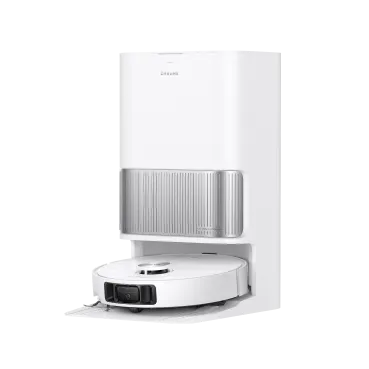
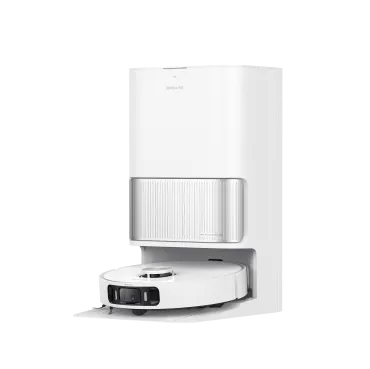
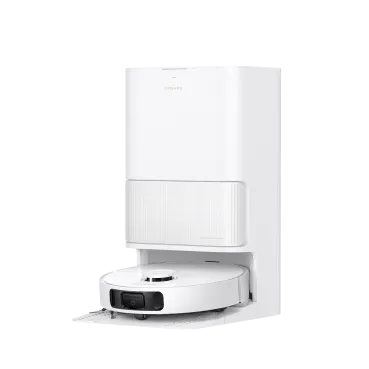
Which Dreame robot vacuums reach into corners?
Can a robot vacuum clean along baseboards?
It cleans along them, not on them. A robot vacuum that cleans baseboards runs its side brush down the strip of floor where the baseboard meets the tile or wood, where the dust line forms. Our explainer on
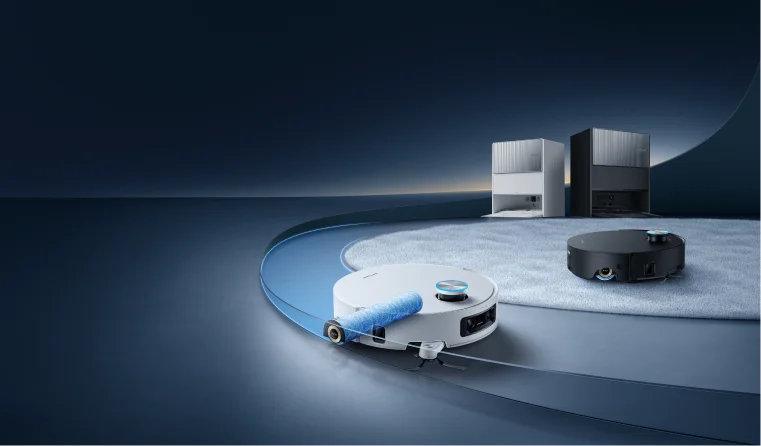
how Dreame vacuums clean edges walks through how the mop arm twists outward to cover that strip, and how the pads tilt into tile grout rather than gliding over it. The vertical face of the board still needs a cloth.
Does an extending mop work on carpet?
No. Corner mopping is a hard-floor job across every model on this page. On carpet, the mop lifts and the vacuum switches to suction only, which keeps the pile dry. The X60 Max Ultra Complete raises its mop 10.5mm clear of the carpet.
Why has my robot vacuum stopped reaching the corners?
Check the side brush every few weeks and pull the hair off it. The brush sits on an arm that swings out past the body to reach the corner, so anything wound around the bristles pulls that reach back in. Some models use an offset brush shape that resists wrapping, but it's still good to make sure that no tangling has happened.
Are round robot vacuums bad at corners?
Not if it has a brush or mop that extends. A round body cannot reach into a square corner on its own, which is exactly what the extending arm is for. Our look at
why most robot vacuums are round explains why the shape handles tight, furnished spaces better, since it turns on the spot rather than needing room to swing around.









 Robot Lawn Mowers

















 Humidifiers


 Smart Door Lock


 Australia
 中国大陆
中国大陆 日本
日本


 Türkiye


 Ireland
 Portugal
 Italia
 Netherlands
 Belgium
 Greece
 Polska
 Norway
 Sweden
 Finland
 Denmark
 Hungary
 Czechia
 Slovenia
 Croatia
 Switzerland
 United
Kingdom
United
Kingdom
 Canada


 Colombia

